
Machine Learning Accelerates Peptide Purification
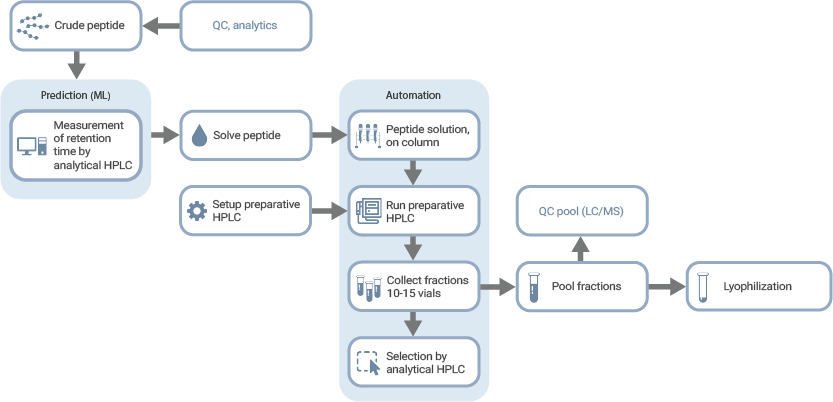
Synthetic peptides have become indispensable in modern research, diagnostics, and the development of new therapies. Whether in vaccine design, drug screening, or personalized medicine, the demand for peptides is growing rapidly. At the same time, the requirements for speed, reproducibility, and process reliability in laboratories worldwide are increasing. While peptide synthesis is now largely automated and scalable, one process step often remains a limiting factor: purification. Traditionally, peptide purification requires time-consuming analytical scout runs, manual gradient setting, and manual fraction collection. Especially with many or changing sequences, this approach leads to a high workload and limits throughput in the laboratory.
This is exactly where our new approach comes in.
With the help of machine learning, we are consistently simplifying and automating peptide purification. A model trained on 1,311 peptide sequences accurately predicts the retention time of individual peptides. This is based on physicochemical properties such as hydrophobicity, net charge, sequence length, and amino acid profile. A support vector regression model with high predictive accuracy (R² = 0.89; MAE = 0.18 minutes) is utilized. The predicted retention time is directly integrated into the automated semi-prep HPLC process. Samples are injected, chromatographically separated, and only fractions within the calculated time window are collected.
The Result
Purities of over 80 percent with average yields of around 82 percent – with significantly reduced time and effort. This means that peptide purification can be planned in a data-driven manner and scaled reproducibly for the first time. Machine learning thus becomes a practical tool for resolving bottlenecks in peptide production and efficiently implementing high-throughput processes.